skip to main |
skip to sidebar
 There's something quite neat and satisfying in Middle Of The Road deposing Dawn at number one; both songs have managed to transcend their disposable origins by showing that, no matter how much they are despised, a catchy pop hook will always have the power to enter the national consciousness with the irritating persistence of a nursery rhyme. The same applies when it's got 'issues' (like Chumbawamba's 'Tubthumping') or when it's all a bit meaningless.
Because at least 'Knock Three Times' gave you some context to hang your prejudices on - 'Chirpy Chirpy Cheep Cheep' in comparison is fairly impenetrable. A quick scan online reveals that everything here can be taken quite literally and that it's about a baby bird who finds its mother has flown the nest despite being there and chirping the night before. Other interpretations suggest it runs deeper and that vocalist Sally Carr is actually singing "Where's your momma gone, little baby Don" - social commentary and an abandoned baby! Unless the baby bird was called Don. Which seems a tad unlikely. Some even seem to regard it as a comment on Vietnam, but on this I will make my lack of comment my comment.
Whatever tale you plump for, there's no doubt that someone has been left high and dry, making the chirpiness (sorry) of the song a bit out of step; Carr sings like all her Christmases have come at once while the tune rolls behind her with the upbeat force of a football chant directed at a team who've gone six nil up. All very jolly.
And yet you can't deny that wrapped around such lyrical fluff, it's a strong tune wasted; Queen (or any eighties soft rock band) could have made hay with the opening 'Where's your momma gone?' chant (or maybe they did with 'We Will Rock You') while the chorus itself would have been a gift for any pop (or twee indie) band (I would say that The Pastels picked up on this with 'Truck Train Tractor', but that might be getting a wee bit too obscure).
Yes it's repetitive and yes it's banal, but there's nothing about it that suggests it's trying to be anything other, and on that front at least it trumps the Dawn effort, though both have a terrible habit of staying in your head when you're trying to banish them to Room 101. I'll let you decide whether that's a mark of a very good or a very bad pop song.
 Now here's a question for you; imagine you're living in the flat above the girl/guy of your dreams and you want to get to know them better. What do you do? Do you -
1. Go down, introduce yourself and ask if they might like to go out for a drink sometime, or
2. Unilaterally devise a personal code that even the Bletchley Park lads would have trouble cracking and then spend your nights waiting anxiously for a Morse code type signal that only you can decode?
Ok, maybe I'm being over analytical again and that this type of criticism is like having a go at the realism of Benny Hill's 'Ernie' dying from being hit in the chest by a cake. But hang on - 'Ernie' is a comedy record, it's supposed to be...well, not rooted in reality. 'Knock Three Times' isn't. Or at least it isn't in the hands of Dawn - Tony Orlando may well have been the chief bubblegum gun for hire in the Seventies, but he brought an over earnestness to whatever nonsense he was called on to sing.
I'm reminded in all this of the exhibition fight in Rocky 4 between ex champ Apollo Creed and the Russian Ivan Drago. Creed starts off laughing and joking but soon stops clowning when he realises Drago is taking things rather more seriously. And so it is here; 'Knock Three Times' is a catchy, nursery rhyme type tune tailor made for the under 5's to mime the tapping and knocking actions to and I'd have a lot more time for it if it was dressed up as such or at least had a bit of humour about it. Tony's 'wooahhs' and impassioned 'Oh my darling's on the chorus soon wipe the smirk off your face when you realise they are the work of a man taking things Ivan Drago seriously, a man who regards his unrequited love as a Shakespearian tragedy when in fact he's little more than a creepy stalker with control freak tendencies.
But hint for you Tony - no need to wait for two taps on the pipe, the fact that she doesn't turn up means she ain't gonna show so take the hint eh? But then again, the girl below spends all her nights in dancing by herself so maybe oddness deserves company.
 Britain in the early Seventies was rather a dour place to be. Racial tensions saw the re-emergence of fascistic politics and the rise of the right wing National Front in the face of an economic downtown. Once welcome immigrants came to be seen as an easy target as the root cause of everybody's woes, bolstered no end by Enoch Powell's infamous 1968 'Rivers Of Blood' speech. The hope and promise of a multi-cultural society generated by the arrival of the Empire Windrush in 1948 seemed distant.
Not that I intend venturing into the world of politics, but I think bit of context is important here. In terms of popular music, reggae was still very much a new sound and although The Beatles were early adopters who appreciated it's worth (with 'Ob-La-Di , Ob-La-Da.'), the initial fan base take up in the UK was with the working class skinhead subculture. Odd then that examples of the genre should find themselves at number one both in 1969 with Desmond Dekker, and now again in 1971 with 'Double Barrel'. Odd, but no mean feat and something worthy of celebration in itself (along with a crushing sense of disappointment that the British record buying public have long abandoned such a willingness to embrace the shock of the new).
'Double Barrel' is a bit of a hybrid - producer Winston Riley came up with the backing music and Ansel Collins played it. Jamaican toaster Dave Barker was asked to provide the vocals. And it's his toasting that raises 'Double Barrel' out of the realms of the ordinary. Sure the tune is a fine, up-beat Ska rhythm jogged along by the usual spaced out piano and woozy Hammond, but it's nothing that sticks in the mind once it's over. Two barrels maybe, but only one is really firing - Dave Barker's
Barker's opening gambit of "I am the magnificent. I'm backed by the shack of a soul boss most turnin' stormin' sound o'soul" is memorable. A proud boast that's both humorous and deadly serious at the same time. And it doesn't end there, Barker is all over 'Double Barrel' like a plague of locusts - "Build it up", "One time", "Work it on baby" - his interjections jockey the record along, papering over the bland colour of the music and providing a template for future Rap MC's to follow. So much so that he must be feeling a bit miffed at the billing on the sleeve - Ansel and Dave Carter might be a more accurate description of what's in these grooves, particularly as their next single 'Monkey Spanner' showed this was no fluke.
 T Rex started out in life as Tyrannosaurus Rex, an acoustic duo of guitar (Marc Bolan) and bongos (Steve Peregrin Took) who pedalled a spare and folksy sound in a series of airy fairy albums (“My People Were Fair And Had Sky In Their Hair” et al) designed to appeal to socially inept Sixth formers who'd read way too much Tolkien – you know the type: “that’s a six, your elf has attacked my orc in the enchanted forest glade”. A bit stereotypical maybe, but I’m in that mood. Bad eggs.
By dropping the name to a simple T, plugging in the guitars and adding bass and drums proper the band and their songs were given a major jump start and re-boot. Although Bolan's head was still in Middle Earth when 1970's 'Ride A White Swan' single lit the touchpaper, by the time 'Hot Love' came around there was more change afoot than simply going electric.
Change in some areas anyway - the lyrics are still so much a nonsense exercise in junior school rhyme ("Well she ain't no witch and I love the way she twitch u-huh-huh"), but wrapped in their new electric cloak they attain a patina of sensuality in Bolan's mouth that they wouldn't have if they were left bare. Not that Bolan ever had a soulful bone in his body, but anybody would be hard pressed to come up with a more sexily predatory sound than that on 'Hot Love'; the title alone reminds of a Swedish porno loop and Bolan coos and groans his words over a loose and loping bassline and guitar riff that thrusts randomly in and out of a mix that comes bathed in its own red light. The Dungeons and Dragons boys wouldn’t have been impressed.
Though he came to be closely identified with the brash glitter of Glam rock, 'Hot Love' is too smooth and simmering to rank alongside the usual in your face, campily macho yob stomp that prevailed through most of the genre; it's far too playful and slinky for that. Honest too - less camp and cerebral than Bowie, less ‘last gang in town’ than Slade and less just plain odd than Gary Glitter; Bolan is only out to get into somebody's knickers and 'Hot Love' is a track designed to appeal to the girl fans only too willing to let him in. The lads may well have wanted to be Bolan, but without the attendant charisma or the sly wink of his seduction techniques then they were always on a hiding to nothing whenever Marc was around, in any form.
No wonder that the endlessly looping 'lalalalala' singalong ending is less the lumpen, arms linked chanting that closed 'Hey Jude' and more the sound of Bolan celebrating the best sex of his life with the cackling glee of one who knows he's cracked the Rosetta stone that leads to pop immortality at last and has finally made it. For a year or two anyway.
 After the loose, good natured breeze of 'In The Summertime', the headlong bull charge of 'Baby Jump' comes as something of a shock with the psycho blues, mutant piano runs and Dorset's leering vocal fair taking the breath away. For about the first thirty seconds anyway; the initial spike on the cardiogram soon settles into a flatline when the constant barrage of one key noise wears with its inherent boringness and the curtain is pulled back on the initial rush of primal lust to reveal some giggling schoolboys trying to re-write 'Louie Louie'.
The idea seems to be that if you play loud and fast enough then the song will take care of itself, but no plugs are sparking here and the unnecessary false ending is used as little more than a device to extend things already dead well past their natural length; rather than engendering another burst of excitement, the feeling when the music starts up again is more one of 'Oh Christ, no more please'.
What it's doing at number one is anyone's guess (and who plays or even remembers it anymore?), though a national postal strike that hampered the return of reliable sales data may be partly to blame. What's odd too is that the moral campaigners who seized on the 'Have a drink, have a drive' line from 'In The Summertime' have turned a blind eye to the paedophilic "I dreamt that I was Humbert and she was Lolita" lyric here, but this itself predates The Police by a good nine years and sets up the cracking pub quiz question 'Name the first number one to namecheck a Nabokov novel'. So all is not lost.
 It was the first solo number one for any of The Beatles, but what's less widely known is that 'My Sweet Lord' was originally written for Billy Preston who recorded it first and that it was pencilled in for release as a single on Apple. For one reason or another it was pulled at the last minute and Harrison's own recording became the hit, but regardless, it's useful to compare both versions here.
Preston takes the song at a fair clip with a to the fore vocal that runs a constant battle with the equally dominant backing singers until the mood is almost revivalist. After a chunky acoustic opening, Harrison takes things at a far more sedate pace, slowing the melody to a dreamlike wash of languid slide guitar that recalls his own 'Something' and which emphasises it over his own mellow, understated vocal. Preston sings like he's addressing a congregation, but Harrison almost murmurs the lyrics in quiet contemplation, so much so that listening to the repeated "I really want to see you. Really want to be with you" feels like eavesdropping on a man in prayer and an invasion of privacy. Even the backing vocals keep a respectful distance.
Ah, the backing vocals. It's hard to broker any discussion of 'My Sweet Lord' without mentioning the plagiarism suit - so, does it sound like The Chiffons' 'He's So Fine'? Well yes and no. The similarities more or less begin and end with the chorus to 'He's So Fine' and the brief melody picked out by the backing singers as they chant 'Hallelujah' and Hare Krishna'. The likeness is undoubtedly there in Harrison's, albeit fleeting, but in Preston's faster and more forceful version you'd be hard pressed to pick it out at all. Which leads to the conclusion that any similarities are purely down to the song's pacing rather than any conscious decision on Harrison's part to imitate.
The litigation dragged on for years until the judge in Bright Tunes Music v. Harrisongs Music decided Harrison had 'unintentionally copied' the tune and ordered most of the royalties to be surrendered. The merits of the argument and the decision are for another to comment on*, but the whole circus froze Harrison into creative paralysis for years. The outcome? A shocking waste of time and talent that resulted in Harrison never again sounding as carefree and at peace with himself on record as he does on 'My Sweet Lord', a non preaching song of devotion and faith that even an atheist would enjoy.
* Though I will say that it was probably Harrison's name and fame that ignited the litigation rather than any genuine belief he'd been stealing someone else's song - how else can you explain the gross unfairness when there are other, far clearer examples of tunes being ripped off shamelessly elsewhere at the same time? What is the riff of Deep Purple's 1970 hit 'Black Night' if not a blatant steal of Blues Magoos' '(We Ain't Got) Nothin' Yet'? What is Lou Reed's 1970 song 'Sweet Jane' if not simply a sped up version of Tommy James' 'Crimson & Clover'? And so on.......
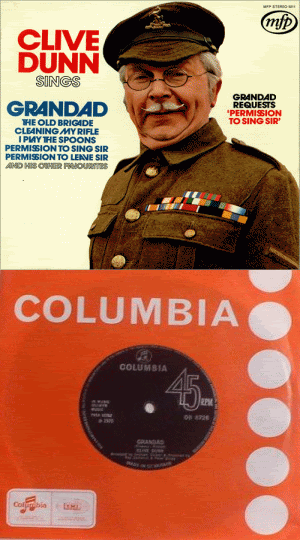
 Clive Dunn would appear to have forged an entire career out of playing doddery old men, the most famous being Corporal Jack Jones from television sit com Dad's Army. True to form, Dunn simply carried his Corporal voice and persona across from show to single to perform this to the extent you expect him to break into 'They don't like it up em'' at every line.
Not that the 'Grandad' in this song would be half as animated or enthusiastic as Jones was on parade - this one is a half senile old fool, scared of his own shadow, confused by 'Telephones and talking things' with one eye stuck firmly in the past while the other gazes wistfully at his imminent demise ('Now my days are gone'). Around him, a gaggle of schoolkids tell him he's 'lovely', presumably because he's too useless to do anything else. It's not exactly a cheery picture of old age and it's made slightly disturbing by the fact that Dunn was only 50 when he recorded it.
What's more disturbing is that behind it were uber session man Herbie Flowers and The Creation's Kenny ('Makin' Time', 'Painter Man') Pickett, though I'd like to think that not too much midnight oil was burned in its writing and that tongues were never that far from cheeks. Dunn's presence helps dilute the wailing of the brats and make this slightly more palatable than 1980's 'There's No One Quite Like Grandma', but not by much. But perhaps the most disturbing thing of all is how serious Dunn seems to be taking it all (serious enough to go on to record an entire album of this half baked nostalgic whimsy anyway), whereas a few shouts of 'Don't panic!' and that funny noise Jones used to make when he got excited would have made it more palatable still.
 There's something quite neat and satisfying in Middle Of The Road deposing Dawn at number one; both songs have managed to transcend their disposable origins by showing that, no matter how much they are despised, a catchy pop hook will always have the power to enter the national consciousness with the irritating persistence of a nursery rhyme. The same applies when it's got 'issues' (like Chumbawamba's 'Tubthumping') or when it's all a bit meaningless.