Saturday, 21 March 2009

1972 Slade: Take Me Bak 'Ome

'Coz I Luv You' was the start, but by 'Take Me Bak 'Ome' there was no denying it - Slade had fully embraced every Glam cliché in the book. A fuzzy, two chord guitar lead, a stomping drum and handclap beat a monkey could follow and a chorus designed for nothing else except shouting out loud, it was all there. Everything except a decent song that is - Slade's tale of trying to pull a woman pissed up on brandy, only to be thwarted by her boyfriend(?) who 'looks twice the size of me' has a certain earthy humour, but it's a lyric that's trying to be sledgehammered into a tune that simply isn't there.

Noddy is game as ever and yells this one like the odds on favourite in a 'Sing Yourself Hoarse' competition, but his exuberance can't hide the fact that 'Take Me Bak 'Ome' sounds more like a rough demo or a half written chorus that's been given a studio gloss rather than the finished article. As a final throw of the dice it gets louder and wilder as it moves toward the end until the beat sounds like a sampled industrial press, but the effect is more one of desperation that genuine excitement. Even Glam Rock needs more than that to hold the interest. Probably Slade's least memorable number one.


Friday, 20 March 2009

1972 Don McLean: Vincent

The first of two number ones this decade 'about' painters, whilst Brian & Michael were content to summarise Lowry's life at arms length on 1978's 'Matchstalk Men And Matchstalk Cats And Dogs', Don McLean has rather more empathy with a certain Vincent Van Gogh. Though 'empathy' doesn't come close to describing Don's admiration for the man - on first name terms from the off, McLean has an interchangeable father/son, psychiatrist/patient, critic, lover and confidante relationship with the artist that elevates Van Gogh to an untouchable Christ like figure out to save the world with a pot of paint. It almost makes the listener feel guilty just for being alive; it's all 'our' fault apparently:

"For they could not love you, but still your love was true

and when no hope was left in sight on that starry starry night.

You took your life as lovers often do"


Of course, McLean himself is blameless in all this, he clearly 'could' love Van Gogh and his song maps a definite 'us' and 'them' separation between the tortured artist and the beer swilling Philistines who can't appreciate the way a sensitive soul can:


"But I could have told you Vincent

this world was never meant for one as beautiful as you".


Heaven save us from those who don't know much about art but know what they like eh Don? I'm sure Vincent would have appreciated your shoulder to cry on, but as he lived his life with a passion and intensity I doubt he'd have had too much time for this sentimental, awkward and ultimately hollow thumbnail biography, in much the same way that 'us' listeners don't much care to be patronised by a songwriter intent on creating his own mythos by borrowing somebody else's.


This may have worked to some extent with 'American Pie' (a song I have my own love/hate relationship with), but then he was tapping into a (by 1972) long tradition of rock stars checking out early. It doesn't work quite so well when transposed to Dutch Post-Impressionist artists and though 'Vincent' fair drips with a cloying sincerity, it makes for a dreadfully dreary four minutes. "La tristesse durera toujours" indeed, but McLean would probably shake his head and give me that condescendingly smug look he wears on the cover:


"They would not listen, they're not listening still

perhaps they never will".


Perhaps. But sorry Don, it really doesn't feel like any loss of mine.


Thursday, 19 March 2009

1972 T Rex: Metal Guru

Not their loudest single ('that would be 20th Century Boy'), but certainly their fastest: 'Metal Guru' plays it's hand from the off with the 'Metal guru, is it you' hook nailing it four square to the Glam tidal wave without pause for breath until the end two and a bit minutes later. From the opening 'AaaaawhYeahOaaaaah' shout, it's a breathless rush of piled on thick guitar and 'Yeah Yeah Yeah' backing that dares you not to get caught up in its shiny grandeur, but the pummelling also serves to distract from the honest observation that Bolan's well of inspiration was starting to run dry.

Whilst 'Telegram Sam' 'borrowed' the main 'Get It On' riff, 'Metal Guru' reprises 'Hot Love's 'la la la' coda and tarts it up with added slam and a set of lyrics that for once sounded like they meant something. And although it is a far better song than 'Telegram Sam' and has Bolan going for the throat, his voice is slightly too fey to do shouty properly and his distinctive squeal doesn't help disguise that we've been here before.


As with most Glam Rock, there's a relentless stupidness to 'Metal Guru' that makes it seem like two minutes of banging your head against a wall. But I don't mean that in a negative way - there's a relentless stupidness at the heart of most Heavy Metal too, and I'm a big fan of the genre. Bolan's "silver-studded sabre-tooth dream" could have come straight out of Spinal Tap, but while that film was piss-take writ large, Bolan (and the Glam movement en masse) were never above self referential piss-taking of their own. 'Metal Guru' has just the right mix of style and substance to give it the legs to escape the twin traps of idiocy and pretension that a lot of the Glam bands got caught in, and by the time the song fades out, Bolan sounds like he's just along for the ride like everybody else.


Wednesday, 18 March 2009

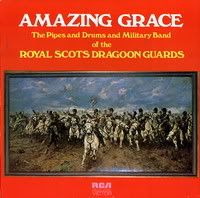
1972 The Pipes & Drums & Military Band Of The Royal Scots Dragoon Guards: Amazing Grace

You know that hymn 'Amazing Grace'? Well this is an instrumental version of that. Played on bagpipes. That's what this is - it's 'Amazing Grace' played on bagpipes. At number one.

I've been trying to find out if there was any film or TV tie-in that could explain its popularity but I've drawn a blank - I know that Scotty played it on his bagpipes at Spock's funeral in 'Wrath Of Khan', but 'Amazing Grace' seems to have got to number one in 1972 on its own merits (though I vaguely remember a public information type film on TV at the time featuring a Scottish regiment, a castle and some fog that may or may not have had this as its backing).


What you make of it all will depend on what your views on:


a) the hymn itself

b) the sound of bagpipes.


While I've no beef with a), I can't say the same about b) and so this rather leaves me cold. In it's defence, it pleases in its purity and lack of gimmicks (you can't imagine this being released in anything other than 'dance remix' form with a 120bpm backing today), but it confuses in its presentation - just who was buying this and what did they do with it in the privacy of their own homes? It would kill any 'record party' stone dead if you spun it in-between the Marcs and the Rods, and yet it's hard to imagine someone fancying a bit of 'Amazing Grace' and then playing it in isolation. But plenty did, because not only did this get to number one, it was also the biggest selling single of 1972.


As Spock was wont to say, 'Highly illogical'.


Tuesday, 17 March 2009

1972 Nilsson: Without You

Everybody knows that 'Without You' is a cover of a Badfinger track written by two of its members who both wound up committing suicide, that's just pub quiz fodder, but how many have actually heard the song as performed by them? Nilsson's version has passed into the canon as the definitive uberballad par excellence, a performance that builds like ripples from a light piano pebble that become a tidal wave of orchestration on the shore by the end. Badfinger's original is different, a far straighter rock number that goes balls out on the chorus from the off, making this more of a re-working than a straight cover.

There's no getting away from the fact that Nilsson puts the song in a more complimentary setting than the original, with a lush string arrangement that brings out the shine with a slow polish. He's a better singer than Peter Ham too (who lives up to his name on 'Without You' with some overwrought vocalising). True, the potential for vocal gymnastics has ruined many a version of this (take a bow Mariah Carey), and Nilsson's fists clenched, eyes shut wailing too walks the high wire between pantomime and heartbreak, but to credit he always manages to stay on the side of the sincere.


And he does it through restraint; rather than directing his threats to the back of his departing ex, Nilsson sounds like he's howling them to himself in an empty room. It could have made for a slightly chilly interpretation had his voice dominated at the expense of everything else, but Nilsson is too classy to milk it to the dregs and he's content to stay either beneath, alongside but never over the top of Richard Perry's arrangement and to fade the song before it starts to bore.


But no matter who's singing, I've always raised an eyebrow at the overall 'message' of 'Without You'; not so much the chorus, but the lines that precede it: "And now its only fair that I should let you know, what you should know". But why is it fair to apply an emotional blackmail that boils down to 'If you leave I'll kill myself'? It's a petulant boast that, if you pick up on it, undermines the pleading of the chorus and reduces it to self pity.


And the line between self pity and an empathetic emotion is a fine one, the mishandling of which has sunk many a modern power ballad (or a 'power ballading up' of an old song - just look at what Nazareth did to 'Love Hurts'). Sure, big chest baring statements in song are nothing new (the first ever number one 'Here In My Heart' by Al Martino is a classic example), but Nilsson's 'Without You' is far removed from the 'moon in June' heartache of tin pan alley, its rock setting elevates it above all that and in turn sows the seed that led to Diane Warren, Phil Collins and their ilk, very few of whom had Nilsson's grip of restraint. Not that I'm blaming old Harry for the likes of "Keep On Loving You", "The Power Of Love", "I Want To Know What Love Is", "Broken Wings" et al, but by god it's tempting.


Monday, 16 March 2009

1972 Chicory Tip: Son Of My Father

A quick look on Amazon reveals you can find a great many Chicory Tip compilation CDs invariably called 'Best Of' or even 'Very Best Of', suggesting that some careful separation of the wheat from the chaff has been going on in putting them together. But come on - there's only one Chicory Tip song that anybody knows, and it's this one. The one that's usually song one on those compilations and the one that even people who've never heard of Chicory Tip can hum along to.

What's perhaps less known is that 'Son Of My Father' is a cover version of an earlier Giorgio Moroder single. Everybody knows that strident, pre-techno synth riff that drives it, but this was lifted lock, stock and barrel from Moroder's version. In fact. Moroder's song is if anything more 'techno' again; the vocal gains a metallic, Teutonic shimmer and there's some crude phasing effects on the chorus that bloat it out of commercial contention. Chicory Tip trim the worst excesses and tame the beast by corralling it into a more traditional rock mould that emphasises the thumpy back beat over those darn new fangled synthesiser things.*

Lyrically, I've always regarded 'Son Of My Father' as a pop art re-write of Larkin's 'This Be The Verse' - can anybody else hear:

"They fuck you up, your mum and dad.
They may not mean to, but they do.

They fill you with the faults they had

And add some extra, just for you
."

in

"Son of my father, moulded I was folded I was preform-packed.
Son of my father, commanded I was branded in a plastic vac
"

Maybe, maybe not, but regardless of any 'child is father to the man' hypothesising, 'Son Of My Father' is blessed with a shouty, arms aloft chorus that is once heard, never forgotten. Chicory Tip may well be operating outside the Glam Rock framework, but it's a Glam headslam in all but name - Gary without the Glitter if you will. Had this been an original recording then I'd be hailing Chicory Tip as unsung founding fathers of electronica and its offshoots, but it's not. Their main contribution is to add a smart commercial edge, a go-faster stripe on someone else's car that proved so effective it buried the band under it the weight of its success. I mean - can you name another Chicory Tip song? I rest my case.

*Interestingly, the Moroder version sounds like a song pulling itself in two. One way was heading down the cheesy Europop route that Aqua, Baccara, Ace Of Base, etc would travel while the other heads toward pioneering an electronic dance sound that would explode in the eighties. There are plenty who would damn Moroder to hell for both of these developments.

Sunday, 15 March 2009

1972 T Rex: Telegram Sam

My least favourite of T Rex's quartet of chart toppers, 'Telegram Sam' finds Bolan embracing Glam Rock (and all that Glam Rock entails) with a great big hug that laid a curates egg of a song. We've been here before. Sort of. The 'Get It On' riff is recycled and beefed up until it crunches with a glam rock fizz, an adrenalin rush that tries so very hard to gloss over the nonsensical lyrics by making it's volume a statement by itself. Tries, but nobody is passing the cigars around on this.

Gone is the seductive billing and cooing of 'Hot Love' and 'Get It On' itself and in it's stead come 'Jungle Faced Jake', 'Golden Nose Slim' and the rest of the gang, a roll call of in jokes that deprive the song of any emotional anchor or point of reference. True, the self effacing "I ain't no square with my corkscrew hair" raises a wry smile, but even a Bauhaus cover that put it through their twitchy Goth machine couldn't disguise the fact that these lyrics are by and large horrid.


Being workmanlike pop that's as disposable as a Bic,'Telegram Sam' is the sound of Captain Bolan partying with the cabin crew while the plane is left circling a holding pattern on autopilot. What was it I said about complacency?