Thursday, 8 October 2009

1979 Blondie: Sunday Girl

The fourth single off Parallel Lines and the least interesting - from the inverted 'Then He Kissed Me' riff in, Blondie are back from the disco and in familiar fifties/sixties pop pastiche territory. Nothing wrong with that, it was their stock in trade over their first two albums, but in comparison 'Sunday Girl' lacks any bite, and though the choppy guitar chords and swirling Hammond try their best the end result is pop candyfloss saved from total anonymity by Harry's vocal.

Never the most versatile of singers, she flexes her full range over 'Sunday Girl' from the innocence of "I know a girl from a lonely street", the yearning drawl of "She can't catch up with the working crowd" to her New York snarl on "Baby, I would like to go out tonight" - it all adds up to a song you never quite know how to 'take'. It's a bi-polar listen for sure, but it's one that keeps the listener on their toes, which is more than the pedestrian backing does. My favourite version of the song is the English/French vocal hybrid that Mike Chapman mixed especially for the original 'Best Of Blondie' album where Harry's Francophile coos add another unexpected dimension to the tune, a whiff of the exotic amongst the ordinary. That's not the version that got to number one, but maybe it should have been.


Tuesday, 6 October 2009

1979 Art Garfunkel: Bright Eyes

Written by Mike Batt of Wombles fame, 'Bright Eyes' concerns a different set of underground/overground creatures altogether, namely rabbits. First, I should point out that though this is from the soundtrack of 'Watership Down', I've never actually seen the film. And that's because I'm the sort of person who can happily sit through any amount of Italian splatter or Japanese torture porn without batting an eyelid, yet show me some talking, cartoon animals suffering any kind of misfortune or harm and I crumble. Tom and Jerry violence yes, but rabbits killed and hounded from their dwellings then persecuted to death by man and beast for 90 minutes is not my idea of entertainment - just the promo video for this upset me in 1979 so I've stayed away from the film ever since.*

Does that fact spoil my appreciation (or otherwise) of the song? I think not - even when divorced from it's original setting it remains a gloomy prospect with Garfunkel's angelic vocal carrying a hint of the afterlife and a conviction of dread and impending doom in this one that's applicable to any living entity about to go gently into that good night. "How can the light that burned so brightly suddenly burn so pale?" - you don't need to have any knowledge or love of 'Watership Down' to appreciate the sentiment behind the song and in that respect its hovering on the cusp of life and death lyric is a companion piece to 'Seasons In The Sun'.

Which means it's something that will draw the usual 'soppy', 'mawkish' criticisms from the usual people, but to my mind 'Bright Eyes' is an unsettling, mildly disturbing ("Following the river of death downstream" - Art's voice makes dying sound welcome, much like the tone of Blue Oyster Cult's '(Don't Fear) The Reaper') song with a genuine power that needs that big deep breath hook of the chorus to warm up the chill. Befitting perhaps for a song that played at number one the week Margaret Thatcher first won power in the UK.


* Which is more than I've seen of it's spiritual sequel 'The Plague Dogs'. Just looking at the picture on the poster of that is enough to set me off.


Sunday, 4 October 2009

1979 Gloria Gaynor: I Will Survive

I once read a review where 'I Will Survive' was touted as a seventies version of 'Respect'. It's a neat idea, but it's one that misses the mark - 'Respect' in the hands of it's author (Otis Redding) is a thinly disguised whinge from a bloke wanting his woman to open her legs on cue when he gets home in return for the money he earns. Aretha Franklin's far superior version turns the tables and recasts it as both a plea for racial tolerance, a call for female empowerment as well as a wagging finger to keep her man in his place. It's a multi-focussed assault that you won't find in 'I Will Survive', a song that can only really be taken one way.

What's always appealed to me about 'I Will Survive' is the conversational tone of the lyrics. Yes they have meter and rhyme, but in essence Gaynor is addressing her former lover in words that could have been overheard through a thin wall, written down as prose and then set to music - "I should have changed that stupid lock, I should have made you leave your key. If I'd known for just one second you'd back to bother me" - it's meat and potatoes, soap opera script, but its directness when married to the thumping disco beat gives 'I Will Survive' energy and clout. And to cement that particular score, Gaynor puts in a bravura vocal of gutsy determination that, after the uncertainty that intimates false hope for reconciliation on the fractured opening ("At first I was afraid I was petrified, kept thinkin' I could never live without you by my side") she soon pulls down the shutters and from then on brooks no suggestion that some sweet talking is going to change her mind.


"Go on now, go. Walk out the door. Just turn around now. Cause you're not welcome anymore." - each phrase ends with a definite full stop amplified by the purely functional, no frills backing that provides Gaynor with the musical backbone to bounce her lyrical one off. The fact that it's gender/sexuality neutral to gives the message of strength and independence a universal appeal for the downtrodden everywhere to take the earth rather than wait to inherit it. By the end, we don't know if Gloria has survived, or whether her outburst is just bravado and that she's really getting out the razors and running a hot bath, but it doesn't matter. The song is adaptable enough for anybody to fashion their own finale, all Gloria is doing is giving you a shove in the right direction.


''I Will Survive' has become familiar almost to the point that it parodies itself. Certainly it's inherent message has been diluted by too many turns on the irony karaoke, but taken in isolation with a fresh pair of ears then it provides a welcome relief from some simpering 'lover come back' soul or the exaggerated joy of lesser genre tracks - there's joy here, but it's joy in strength, personal fulfilment and the sheer pleasure of saying 'fuck you' and meaning it.


Friday, 2 October 2009

1979 Bee Gees: Tragedy

It's a fair question I suppose - how do you follow up a runaway, multi million success like the 'Saturday Night Fever' soundtrack? To take the example of the other act tasked with following up a widely popular album in 1979 - all the world wanted from Fleetwood Mac was 'Rumours Part 2', but in 'Tusk', Lindsey Buckingham gave them an album that was hell-bent on providing anything but.

With 'Tragedy' (and in the 'Spirits Having Flown' album), the Bee Gees weren't about to throw the baby out with the bath water and it ploughs the same furrow they ploughed at the discos in 1978, only moreso. A hell of a lot moreso in fact. The playful lightness of touch on the 'Saturday Night Fever' songs is gone, replaced with a dense carpet bomb of sound that paints the break-up of a relationship as scene from the book of Revelation. "Here at night in a lost and lonely part of town, held in time in a wad of tears I slowly drown" - it's a heavy duty palette of angst spread thick by those falsetto vocals that no longer swoop around the melody like birds in flight but squeal like animals in pain. "It's hard to bear, with no-one to love you you're going nowhere" - there's a desperation there, but it's more the desperation of the Gibbs trying to convince their audience that the scale of this 'tragedy' is worthy of the Wagnerian bombast.


But in fact it isn't. It's too much and too self indulgent. I like 'Tragedy', like it a lot even, but I can't honestly say it's a truly enjoyable listening. I can do overwrought angst as much as the next man, but whenever I'm in the mood for a bit of self indulgent misery there are other artists on whose door I'll knock long before I arrive at the Bee Gees. For a pop cum disco track it's too long, too dense and too serious; there's nothing ironic or playful going on here, and while there's undoubtedly a fine song in there amongst the debris, the real irony is that it took the no nonsense pop assault of Steps to sift it out. As performed by the Bee Gee's, it's the sound Nero should have produced on his fiddle as Rome burned around him.


1979 Blondie: Heart Of Glass

But of course, if I'm going to go on about disco bandwagon jumpers then there are no more glaring hoppers on than Blondie. Prior to 1979, as far as the UK was concerned, Blondie were post CBGB/New Wave skinny tie also-rans distinguished chiefly by being fronted by one of the most photogenic women in the history of popular music. Indeed, 'Heart Of Glass' wasn't consciously born as a disco song at all. In it's early incarnation as 'Once I Had A Love' it was a cod-reggae led shuffle in keeping with much of their early output and responsibility for it's disco re-wiring can be laid solely at the foot of producer Mike Chapman, a veteran of the UK's seventies Glam Rock scene and every bit a bandwagon jumper as the band.

'Heart Of Glass' stands alone in Blondie's output. Though the whole of the parent 'Parallel Lines' album had Chapman cleaning up Blondie's fifties trash sound into something more mainstream orientated, nothing else on there sounds as blatantly slick and danceable as 'Heart Of Glass' (the band took to referring to it as 'the disco song); it's where Chapman really went to town and it's as much 'his' song as that of Debbie Harry and Chris Stein who ostensibly 'wrote' it. Driven on a slinky low key guitar riff and high hat rhythm, 'Heart Of Glass' is one of the sparest sounding songs Blondie ever put their name to with their usual dense pop clutter of guitars, hole plugging keyboard stabs and Clem Burke's rolling flat kit drum fills exorcised in favour of a more organic 'I Feel Love' pulse.

Yet whereas Summer's orgasmic cooing got the more conservative listeners hot under the collar, the detachment of Harry's 'couldn't give a toss really' "Ooh ooh ooh whoa's" and complete absence of trademark vocal snarls delivery exudes an icy coolness of mocking indifference that always remind me (ever since I saw the film anyway) of the indifferent icy cool, 'couldn't give a toss-ness' of Marlene Dietrich performing 'Falling In Love Again' in Sternberg's 'Der Blaue Engel'. It's clear that her Lola is not capable of true love, but she presents a persona seductive enough to reduce Emil Jannings' 'Professor Rath' to destitution in his fruitless pursuit to win it. "Once I had a love and it was a gas, soon turned out to be a pain in the ass"; it's easy come, easy go for Ms Harry too, but her indifference is just as attractive.


And on that front, whilst it's true that Ms Harry would look good in a face pack and potato sack, the promo videos for previous Blondie singles were still pushing the punky, urchin, not trying too hard look but there's no doubt her scrubbed up, made over visage in the 'Heart Of Glass' video helped seal the deal with a generation of adolescent Professor Jannnings howling at the moon in their bedrooms (I wasn't going to revert to a lazy remembrance of how much I fancied our Debbie back then but I seem to have arrived there anyway - ok, I was one of them. I fancied Debbie Harry big time in 1979. And 1980. And 1981. And 1982........). And who wouldn't be howling with those 'come to me' smiles framed by glistening red lips that spark with friction off those cold 'now piss off' eye rolls - "Love is so confusing, there's no peace of mind" - don't look to Debbie for an easy ride.

By embracing the mainstream they originally purported to be kicking against, 'Heart Of Glass' wound up many long standing fans and purists who were quick to cry 'sell out' (filming that promo video in Studio 54 when previously they were part of CBGB's only wound the same folk up a further notch). And fair enough, 'Heart Of Glass' may well be an unusual Blondie song, but even if it was a sell-out of sorts, the most ardent naysayers couldn't deny that it was a damn fine one. Damn fine.


1979 Ian Dury & The Blockheads: Hit Me With Your Rhythm Stick

Another song, another memory. Two memories to be exact, one true and the other false. What's true is that 'Hit Me With Your Rhythm Stick' was the first single I ever went into a shop by myself and handed over my own money to buy. So that makes this a landmark of sorts, the popping of my record buying cherry. The false memory is that I would have sworn on a stack of bibles that this was number one at the tail end of 1979 rather than the start as I was listening to it around Christmastime, but as it was released in November 1978, it means I actually bought it before it was number one, which makes me all the cooler I think.

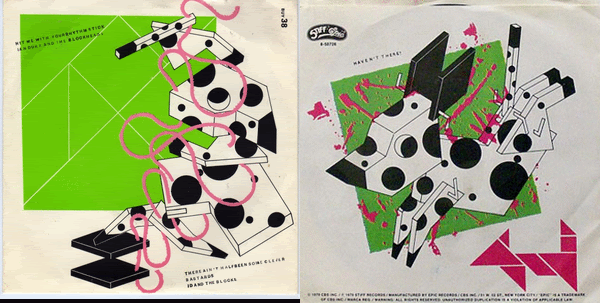
Why did I buy this? Well I was caught up in the mystery of it all, from that splendidly cryptic Barney Bubbles sleeve (so good I thought you should see both sides) to the evocative travelogue that pours from Dury's mouth. What helped my interest too is the genuine edge of rebellion that buying it engendered. Up until then, mine and my parents taste in music usually ran on the same rail - I only ever really listened to whatever they played and they liked 'Grease' as much as I did (in fact, they took me to see the film when it came out). My father, however, was no fan of Dury's and his headshaking comment of '
I'll bloody hit him in a minute' after watching this on Top Of The Pops generated a frission of friction between us, the first time I realised there could be a difference between what my parents liked and what I did.*

But away from all that, the reasons I liked 'Hit Me With Your Rhythm Stick' in 1979 are basically the same reasons I still like it today. Again, it's the mystery - Dury presents an almost uncrackable code of a lyric in a free flow of onomatopœia rhymes and scattershot imagery that recall Dylan at his best (though I know that last comparison will turn off as many people as it will turn on). As a lyricist, Dury was always at his best when he had characters to work with and a setting to put them in but on 'Rhythm Stick' he doesn't; the song (or rather the song's subject matter) itself is the character - that is, the universal pleasures of music and dancing.


It's a perfect convergence that keeps the song moving ever onward in a fluid wave of rhythm that's ideal dancing fodder for anyone made of rubber, with a chorus that, as if to stress the all embracingness of the tune, on each repetition includes a different line starting in French and answering itself in German. Clever yes, but not
too clever clever 'by half', and it's subsumed into a groove fed by Norman Watt Roy's spider walk of a bassline so completely that you barely register it until it's passed. Play that funky music white boys.

What this means is that 'Hit Me With Your Rhythm Stick' is perhaps unique in Dury's output in that an understanding of English is not required to appreciate what he's trying to say. And that's because, with an already crack backing band in 'the Blockheads', Dury's vocal becomes just another instrument in the mix with the lyrics playing out as further notes varied in tone and stress - just compare the shift in emphasis on "
In the wilds of Borneo, and the vineyards of Bordeaux" for evidence of Dury's loving embouchure of the syllables almost in the manner of a jazz scat singer until he breaks into almost Peter Brötzmann free form squawking ("HIT ME!!!") on the outro.

In short, a wonderful single and a wonderful number one.


* Not that I turned into an angry young man overnight - I can remember hiding the single at home in case someone noted that the B side was called 'There Ain't Half Been Some Clever Bastards'. And you needn't look any further for a classic example of Dury's mastery of English when he had a solid subject to bounce off:


"
Einstein can't be classed as witless.
He claimed atoms were the littlest.

When you did a bit of split-em-ness,

Frighten everybody shitless
."


1979 Village People: YMCA

Now here's another bundle of memories, chief of which is remembering some older boys asking me if I was gay in 1979 and my innocent reply of 'yes I'm feeling happy' causing no end of hilarity amongst them. You see, I had no idea what 'gay' meant or that it was regarded as an insult in my neck of the woods. At age ten I only had the vaguest idea of what heterosexual sex was so anything else was well off my radar. By the time the year was out though, the 'joke' didn't work anymore; everybody knew what 'gay' meant in the sexual sense and I think that little enlightenment can be put down to the success of the Village People, one of the first acts to openly acknowledge the gay community by dressing in outlandishly stereotypical gay fantasy persona and performing music that only hid its message behind the flimsiest of metaphorical curtains.

As far as signature tunes go, they don't come much more signatory than 'YMCA'. Essentially an upfront message of pride that encourages the waverers to embrace their sexuality ("young man, what do you wanna be"?) it's nevertheless a conservatively insular recording in that it recommends the 'young men' (women are not welcome it seems) to go where similar minded people can be found - the YMCA *- rather than pushing for universal tolerance for homosexuality. But as lyric writer Victor Willis (the 'cop' in the line-up) was heterosexual and only tapping into the gay market with 'YMCA', maybe he thought that was more than he'd be able to get away with.

Upbeat and in your face it might be, but I find it difficult to listen to 'YMCA' in these terms as through benefit of hindsight I know that in a few short years the light of carefree optimism would be dulled with the emergence of intolerant right wing governments on both side of the Atlantic and the arrival of AIDS. To that extent, listening to 'YMCA' is like looking at photographs of you and a mate on a night out when you knew he was killed by a drunk driver on the way home.

'YMCA' can still be taken on face value as fancy dress disco with pantomime mimes to spell out the letters with all subtext removed and that's fine. In fact, I've known gay people who bitterly resent the Village People as insulting panderers of faux macho/comic stereotypes to the straight world and are far happier to see 'YMCA' as nothing more than a grown up version of a child's school dancing game. On that level (and in truth it's the only level I'm 'qualified' to comment on) the song still holds up remarkable well for what is basically a tune disco by rote.

A chunky, horn led affair, 'YMCA' is carried along mainly by the vocal and a repeated 'Young man' exclamation until you're essentially dancing to the words rather than the beat. And despite the intended 'young man' audience and shorn of any sexual politics, 'YMCA' still carries a universal appeal in its simplicity and sheer good cheer that can still pack any dancefloor (pretentious white suits are not required here) as soon as the opening brass riff starts up - it's fun to stay at the (deep breath) WIIII - EMMM - SEEEE - AYYYY, but it's bloody good fun to dance to it too.

* According to Wikipedia, the YMCA (Young Men's Christian Association) was a popular cruising and hook-up spot, particularly for young gay men. I can only take this at face value, but I do remember my delight at finding out shortly after this hit number one that my hometown had its own YMCA. My delight turned to disappointment when I went along there out of curiosity - it looked a rather drab, run down affair with gangs of teens drinking cheap cider outside, none of whom were dressed as cowboys or Indian chiefs. Oh the innocence.....