Tuesday, 20 October 2009

1979 Buggles: Video Killed The Radio Star

Although not quite a common household fixture in 1979, video was marching relentlessly over the horizon as the 'next big thing' in technology and, in the eyes of some, it's arrival was something to be feared rather than celebrated. Not feared by everyone, but by those who saw it as erasing the comfort of the past with the shock of the new. By people like Trevor Horn and Geoff Downes, the duo who made up Buggles. Both were professional musicians from disparate backgrounds who would go on to forge disparate careers in music. As Buggles, they weren't one hit wonders but they should have been, though I don't mean that sarcastically; Buggles should have come, made their statement with this song and then departed. Perfect.

Perfect because,as a single, 'Video Killed The Radio Star' is a fully formed creation making a stand alone statement that needs no follow ups or a hastily recorded (and very patchy) album (can you name either)? And that's because it's a multi-faceted song that exists both concurrently and independently on a variety of plains. On one hand it's an elegy for the passing of what Thomas Dolby would soon term 'The Golden Age of Wireless', while on another it's a simple, catchy pop song. Either way, impossible to ignore it's cusp of the eighties setting and the context in which it was operating:


"
I heard you on the wireless back in Fifty Two
Lying awake intent at tuning in on you
".

Lyricist Horn would have been three in 1952 so there's every chance he's writing from memory, and that use of 'wireless' instead of radio is a clever device that ages his own experience and separates it from (for example) my own contemporary exposure to the likes of Tony Blackburn and the gang. In 1979, only my parents still called radio the 'wireless' and Horn is merely pointing out that the ignorance of my generation was part of the problem. And as far as problems go, I'm not sure what can be read into the title refrain of the song being sung in a broad and comically obnoxious American accent,
but it all contrasts with Horn's olde tyme vocal compressed to a mono whine that powers the glow of nostalgia that he's celebrating/mourning.

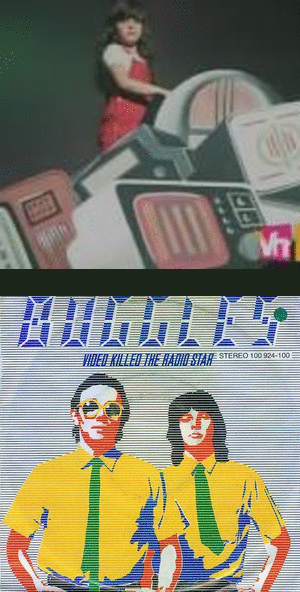
Neither am I sure whether the fact that the song's video was the first ever shown on the then new MTV is ironic or not; was MTV meant to be the 'bad guy' in all this?
A similar song could have been written circa 1927 to mark the passing of silent films with the emergence of sound ('Talkies Killed The Silent Film Star' maybe), while today there's every chance the young girl dialling up the old valve radio in that striking video is now a woman baffled by MP3 players. My point is that times change, they always will yet the people who get most hung up on it are always those who refuse to change with them.

Hindsight has shown that video no more killed the radio star than home taping killed music. It may have prolonged the careers of those where innate talent took second place to image, but in our brave new world of downloads and virtual music that we can never hold, the very concept of 'video' seems as quaint and distant as rationing (in fact, the "
put the blame on VTR" line had almost become obsolete as an acronym before the song was even released).

Which is what music effectively was in 1979, by modern standards anyway - if you wanted to hear this song then your choices were to either buy the single, the album or else wait till it came on the radio. In the course of typing this I've found no less than nineteen different sources where I can stream or download (legal or otherwise) this tune and that's without really trying. "We can't rewind we've gone to far" - that's a lesson that record companies need to learn now that the genie is out of the bottle, but 'Downloads Killed The Video Star'? I doubt it. Music is as alive as it ever was and by that analysis Messers Horn and Downes are a pair of old and in the way party poopers peddling a woefully misguided song.


But isn't all this just a teeny bit pretentious though? On another plain, isn't 'Video Killed The Radio Star' just a novelty song by two jokers with funny hair and big spectacles? Maybe.
There was something insanely catchy and comforting in Buggles, something that showed the those keyboard things could be a good laugh in the right hands. M had hit number 2 with 'Pop Muzik' in April and this was just something out of the same mould. Again, maybe.

And ok, if we're taking it on that level then the song has aged well. Any tricks and traces of late seventies electronica are largely absent and the track is straight, gimmick free with an unforgettable chorus that nags in the brain with the faintest hint of a statement of unrest the way Pink Floyd's '
We don't need no education' shortly would too. But I think there's more to it than that and that such analysis does both Horn and Downes an injustice.

Because let's not forget,
'Video Killed The Radio Star' was co-written by Bruce Wooley who recorded the song first with his band Camera Club (with Thomas Dolby on keyboards, to square this particular circle). In their hands it's an unremarkable, typically 'eighties' synth drenched mess that drives a coach and horses through everything I've highlighted Buggles as achieving. So rather than the song itself having any innate power, it's by their re-recording that Horn and Downes made it remarkable and gave it a new dimension the way, say, Jimi Hendrix turned Bob Dylan's lyrical apocalypse of 'All Along The Watchtower' into an aural one.

I think for me, the key has always been in that video. I've always found something faintly disturbing in the blank yet accusing stare of the young girl after she climbs the mound of junked radios, a kind of 'how DARE you fuck all this up for me?' look which has always conveyed (to me anyway) an intent that this isn't just a camp singalong - "I met your children, what did you tell them'? What indeed?

But as I said, times change and, i
ronically, it's the exact opposite look to the one I get from today's twenty somethings when I try to explain the past joys of buying a seven inch single like this one on a Saturday morning trip to town when nowadays they can listen to it from nineteen different sources without leaving their bed. That's how I understand the song anyway.

But you, of course, can take it anyway you want.


Sunday, 18 October 2009

1979 The Police: Message In A Bottle

The fact that The Police were a) a trio of blonde pretty boys who, b) played reggae has always been an anathema to many. As one who was there, I remember the very title of 'Message In A Bottle's parent album 'Reggatta de Blanc' (which loosely translates as 'white reggae') was like painting a big red target on each of their arses for the purist music writers of the time to kick. And kick they did, because how very dare they? But that's not to say that The Police ever made a career of trying to chant down Babylon - true the rhythms of reggae and ska dominate on at least their first two albums, but rather than promoting any kind of Rastafarian message the choppy guitar lines and prominent bass are used to spice up what would otherwise have been largely ordinary pop songs.

They weren't unique in this either -
reggae was big business down at The Roxy too, courtesy of DJ Don Letts who brought in his own record collection when there were no released punk records to play. The Clash, The Ruts, The Members, Stiff Little Fingers, Public Image Ltd et al all incorporated roots reggae and dub into their music to compliment the rebellion of their own genre, albeit to greater and lesser effect (and certainly to lesser critical mauling). And that Roxy connection is pertinent - that's actually Stuart Copeland on the cover of 1977's 'The Roxy London WC2' album; the punks might have held them in high a regard as the weekly writers, but they were there at the outset. For my own part I'm ambivalent. I've written elsewhere here about my distaste of smug white men playing reggae for whatever reason, but I can't say The Police have ever raised any serious ire within me. When they make it work, they make it work well, but even when they don't the results are rarely less than passable.

'Message In A Bottle' at least tries to make it work; Copeland picks out a standard reggae beat on the kickdrum but hammers the Toms double time on an opening salvo while Andy Summer's B G A E riff cascades hand over fist through the whole song like a waterfall. It's busy, it's unpredictable and it has a ramshackle charm that's fun to listen to; if there's a weak link here then it's Sting himself who provides it. On much of their previous output his vocal is a standard new wave snarl cum yelp, but on 'Message In A Bottle' he unwisely tries to inject some patois into his delivery. Unfortunately, it sounds as genuine as a racist comedian lampooning 'The Banana Boat Song' with his 'sea oh' and 'me oh' inflections and irregular modulation ("a YEAR has PASSed since I WROTE my NOTE") providing a comic aura of novelty that fits ill with its subject matter.


Because in its theme, 'Message In A Bottle' is a precursor of sorts to REM's 'Everybody Hurts' but without the reassurance. Sting is lost and alone in a world that doesn't care, but in reaching out with his message 'to the world' the only responses he gets are a 'hundred billion' similar messages from people in the same boat. So tough luck.

And that's where it ends, though in fact, 'Message In A Bottle' doesn't conclude at all;
by the fade out Sting is in no better place than he was at the start, and the repeated 'I'm sending out an SOS' drags on and on with all the conviction of a social inadequate signing up to a dating website. It's not that Sting is under any moral obligation to square the circle on his metaphorical song of loneliness with a conclusion, but we just don't care enough to care; desperation is a very unattractive trait and it all goes to make 'Message In A Bottle' an unsatisfying listen at heart and a song I can take or leave. Though mostly I leave it.


Friday, 16 October 2009

1979 Gary Numan: Cars

Just a few short months after 'Are 'Friends' Electric?', Numan ditched the 'Tubeway Army' moniker and went it alone. A risky enterprise on paper, but the Army always were a one man band and the only real change is the name on the cover (the backing band remained the same) - his first solo single, 'Cars', is basically 'Are 'Friends' Electric?' with go faster stripes and shinier hub caps.

I don't really want to labour the Kraftwerk Kraftwerk Kraftwerk, blah blah blah angle, but how can you have the audacity to release an electronic music track called 'Car's without at least namechecking 'Autobahn'? The answer is you can't, or at least I can't, especially as it also makes a cracking point of reference to the previous single. Because whereas 'Autobahn' was a free running song of the open road, Numan uses his own vehicle as a comfort blanket with its mechanical frame shielding him from the real world ("Here in my car I feel safest of all, I can lock all my doors") until it almost becomes an object of fetish plucked from JG Ballard's 'Crash'.


Now, instead of looking at outside through his safe window, Numan is now content to view life through a windscreen, hoping "Will you visit me please, if I open my door"? - you have to come to Gary, he's not coming out to you because "nothing seems right" out there. Alienation, isolation, paranoia - see, I told you Numan was a one trick pony, but after a quick electronic gurgle to clear the throat, 'Cars' races off with sufficient force and melody to stand it apart from 'Are 'Friends' Electric?', though without that song's spoken word passages of heartbreak, this particular car may as well be driven by a robot. Which was kind of the point anyway.


I was a big Gary Numan fan in 1979. I bought this and ' The Pleasure Principle' album and I played them to death, but it also marks the precise point where I lost interest in him. In just two singles, Numan had played every card he held and with 1980's 'Telkon' even the twelve year old me knew the sound of a busted flush when he heard it. But it was fun while it lasted.


Wednesday, 14 October 2009

1979 Cliff Richard: We Don't Talk Anymore

'Round about the time the first punks were plugging in, a voice from the past was re-booting his own image with a comeback of sorts. Not that Cliff Richard ever went away you understand, his chart singles have always been consistent but for the next few years he would tap back his roots to present a rockier image than the family entertainer he'd become. It was a bit like Elvis' '68 Comeback re-told for a PG audience; Richard was never going to zip into a leather jumpsuit or start spitting anarchy, but 'Devil Woman' was a racy enough affair from a born again Christian to raise eyebrows. That's about as far as Cliff was ever willing to push the boat out though; 'We Don't Talk Anymore' is a soft MOR rocker with the bluntest of bites that keeps Cliff in safe harbour.

It's a song that allows Richard to acquit himself well. He's comfortable with the medium, has fun with the key changes and lets rip with some impassioned falsetto that you wouldn't normally have seen coming in something with his name on it. That's all well and good, but it's the music he's given to sing over that let's the song down. It doesn't share Cliff's enthusiasm and instead drags its heels in a chug-a-lug of synth bursts and muted power chords that ring with the conviction of a pub covers band trying to get down with the kids. Cliff's the star here and nothing around him makes any attempt to steal his thunder, but though he has the connections, he can't perform miracles by himself to make this anything other than plain old average.


Perhaps the biggest handicap for 'We Don't Talk Anymore' is its mid-place setting in a year of some sparkling number ones. Posterity has been kinder by merging it anonymously into the amorphous 'Cliff Richard's Back Catalogue' catch all, but coming in-between the Dury's and the Numan's, it's attempt to make Cliff modern and relevant come across as well as comparing a cassette walkman with an Ipod. True, the walkman will always have its fans, but let's not kid ourselves here.


Monday, 12 October 2009

1979 The Boomtown Rats: I Don't Like Mondays

In January 1979, sixteen year old Brenda Ann Spencer of San Diego, California fired shots at children in an Elementary school playground, killing two adults and injuring eight of the kids. When asked why she did it, the only answer she could give was "I don't like Mondays, this livens up the day." A chilling story, and one that would inevitably attract investigative dramatisation or commentary, though it's doubtful that a pop song was the most fitting medium for this or that Bob Geldof was necessarily the best person to have a stab at writing it.

In terms of its theme of violence born of frustrated boredom, 'I Don't Like Mondays' could have been a great follow up to 'Rat Trap', a sequel to form a kind of punky, two part epic version of 'In The Ghetto' that showed what Billy and/or Judy did next, but by basing it firmly in fact (and very recent fact at that), Geldof paints himself into a corner very quickly - how are you supposed to take this? Or more to the point, what ways can you take it?* Because if you're going to be covering events like a real life schoolyard shooting in any meaningful way then a degree of understanding subtlety is required. Geldof, however, has never done subtle terribly well and true to form 'I Don't Like Mondays' is about as subtle as one of the Banana Splits.


"I wanna shoot he whole day down", "The lesson today is how to die"; if an American punk/new wave band had scowled those lines in a song about the Dunblane massacre then there'd be outrage, and understandably so; they are clumsy, crass and totally insensitive. And just because Spencer herself used the glib 'I don't like Mondays' as excuse for her own rampage, it's no justification to glibly compound its insanity by repeating it throughout the course of the song as the hook of the chorus.


It's not that Geldof is deliberately out to cause offence - he's on record as saying he wasn't using the song to exploit tragedy - but his propensity for overwriting sinks 'I Don't Like Mondays', a song geared solely toward the descriptive, to the depths of the lowest common denominator from the word go; just whose 'side' is Geldof on with all this? He sings the chorus in Spencer's persona and, while he's not sympathetic to her, there's nothing here that could be considered heartfelt or accusatory either. The tune itself is not unpleasant, but the song it's hitched to is blank tabloid reportage of the most sensational kind. And where a level of analysis or comment would have been welcome, Geldof is content to cover the front page with the bold 'TELL ME WHY?!?', a cynical device that helps shift units through shock value but leaves a bitter aftertaste. I'm not suggesting that Geldof should have had the answer, but by the same token this was hardly the time and place to ask the question.


* Bon Jovi covered the song at Wembley Stadium in 1995 and was joined onstage by Geldof himself. The incredulous look on Bob's face as Bon Jovi mimes a shooting action with his fingers on the 'shoot the whole day down' line is a picture, but then in providing no moral compass within the song, he only has himself to blame if it's taken as something celebratory. No wonder Spencer's family were pissed off in 1979 and tried to get it banned.


Sunday, 11 October 2009

1979 Tubeway Army: Are 'Friends' Electric?

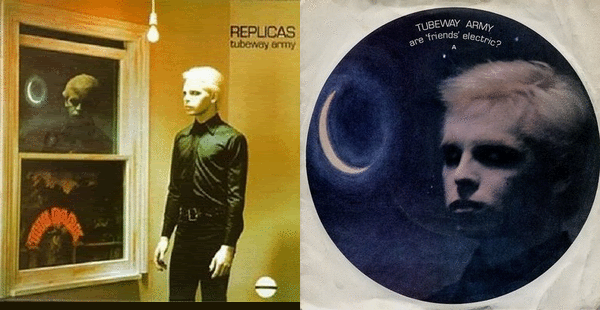
If 'Hit Me With Your Rhythm Stick' represented the milestone of being my first bought single, then as the first album I ever walked into a shop by myself and bought with my own money, then Tubeway Army's 'Replicas' was another. And I bought it largely on the strength of hearing 'Are 'Friends' Electric?' on the radio. It was a permanent fixture over the summer of 1979, though - confession time - the fact I thought Gary Numan looked rather cool and mysterious on the cover played no small part in this purchase. To my impressionable mind, the shot was every bit as 'alien' as Bowie on the cover of my brother's 'Ziggy Stardust' album, especially when I noticed that his reflection in the window didn't correspond with the way he was looking into it. But whilst Ziggy was to be found roaming around at large in central London, Numan was trapped indoors in a bare room, which made it all the more menacing. And it was 'mine'. Mine mine mine mine. So that didn't hurt either. But I'll come back to that.

'Are 'Friends' Electric?' came to my attention fully formed and vacuum sealed, a whole package of sound and vision unlike anything else I'd been exposed to. For a quite some time it was my idea of what the 'punk thing' I'd been hearing about looked and sounded like. It was my only real point of reference; I'd never heard of Kraftwerk in 1979, but Numan had. And how. That whole tight shirt, tie and sensible hair image came wholesale (I was soon to learn) from their 'The Man Machine' era, but whilst such peripherals were easy enough to appropriate, the music was less so; Kraftwerk always ran on oiled ball bearings but in comparison, 'Are 'Friends' Electric?' has a wooden leg fashioned from a minimoog.

But wait, that's not a criticism per se, and the Kraftwerk comparisons are a bit one eyed on my part - after all, the Germans were hardly working in isolation as the be all and end all of electronic music. My point though is that, suffice it to say, most of the music of this type I'd come across at that point tended to be melodic, almost novelty affairs that exploited the metronomic precision that synthesisers could bring to a tune (like Hot Butter's 'Popcorn', or Space's 'Magic Fly' to give two rather perverse examples), or else they were ambient, synth mood washes of sound that did nothing but wash ambiently (side two of Bowie's 'Low' and Tangerine Dream on Virgin were my main reference points at this time). I think it's fair to say there's nothing light or ambient about 'Are 'Friends' Electric?'

If I'm going to maintain the comparison, then Numan's song is the sound of Kraftwerk as played by Black Sabbath - huge, two fisted slabs of doom laden slog wheezing along like an unstoppable steam driven machine, so much so that Numan has to shout to be heard on his own song. Numan had already namechecked sci-fi author Philip K Dick's work on Tubeway Army's debut album, and the menacing paranoia of what Numa
n was shouting could have been cribbed from one of Dick's later novels. In fact, I could fill volumes with the various interpretations that the angst filled adolescent me gave to these lyrics over the years, but all of them concerned alienated outsiders lost in an indifferent world that didn't understand them and offered no place for them to call home (I've repeated some below, for all our amusements).

Which I suppose wasn't really that far off the mark, and this is where that album sleeve became important to me - there was never an official promotional video for 'Are 'Friends' Electric?'* but to my mind one wasn't needed - that cover shot illustrates the song (rather than 'Replicas' as a whole) well enough. When Numan sings:"I
t's cold outside, and the paint's peeling off of my walls. There's a man outside, in a long coat, grey hat, smoking a cigarette"** and: "Now the light fades out, and I wonder what I'm doing in a room like this" then he's singing it from that room while gazing at (rather than out of) that window.***

And the dirge-like tune of 'Are 'Friends' Electric?' seems a fitting soundtrack to that particular landscape, (I like to imagine Numan has it playing loudly on a stereo just out of shot). To an extent anyway - 'Are 'Friends' Electric?' is over five minutes long and there's only so much anybody can take of that major/minor opening riff, but just at the point where you might start thinking about reaching for the off button, it shifts key into a bridge of a cascading synth motif where Numan abandons his android squawk and provides a monologue that allows an element of humanity to creep into the song. The device is repeated again toward the end and each are section is bookended by the "
I don't think it mean anything to you/You see it meant everything to me" complaint that lies at the heart of the track - 'Are 'Friends' Electric? is just another 'my lover's gone' song dressed up as a sc-fi B movie . It seems that even if androids do dream of electric sheep, they can have their hearts broken like the rest of us.

So at heart nothing new, but on the surface it's arguable that the image conscious, synth driven/New Romantic haunted 80's started here and with this. And not only that - it's also arguable that its obscure and angsty tone made Numan a forbearer of the black raincoat, Camus reading indie scene that was just around the corner. Not that I'm claiming any prophet status for him, but the level of critical abuse that has always hurtled his way has been a tad unjustified. Time may have shown Numan up to be something of a one trick pony on just about every front with the ideas first heard on 'Are 'Friends' Electric?' plundered, stretched, re-interpreted and just plain repeated for many years to come. But just as all tricks are at their best when you see them for the first time, the multiplicity of source material and general ham-fistedness struck lucky by generating an originality of its own and a weirdness that doesn't often find itself at number one. Another song that I rarely tire of listening to.


* Adolescent, angst filled interpretation #1:
I placed great significance on the inverted commas around 'friends'. To my mind, Numan was saying people only let you down and you'd be far better off with a robot for a mate. Only they wouldn't be a proper mate because they were robots. So a 'mate'. Then.

** Adolescent, angst filled interpretation #2:
We can't see the man in the hat outside the window, but that's because he isn't there in the physical sense at all. It's just a manifestation of Numan's conscience that wouldn't let him rest. Rather than sourced from any paperback philosophy, this little bon mot was born from hearing Cheap Trick's 'Dream Police' that year. Which incidentally was also the title of a song on the first Tubeway Army album - hey, maybe P.K. Dick was on to something after all.....

*** Adolescent, angst filled interpretation #3:
An outsider looking out at a world that he's alienated from - blimey, what a pretentious twat I was, but to my eternal shame it would get a lot worse before it got any better. But I'm OK now.

Friday, 9 October 2009

1979 Anita Ward: Ring My Bell

Anita Ward's one hit wonder is versatile in its very simplicity; 'Ring My Bell' could easily have been (or could be still be) cast as a bass heavy Northern Soul thumper, but Ward's take is a sharp disco tune that stresses its upbeat lightness from the sensuous electronic pings and pongs on the backing to Ward's excitable schoolgirl high vocal. It's frothy stuff that bubbles like lemonade, with most of the froth coming from Ward herself; her work is done her man is home and now she wants her bell seriously rung. Ahem.

Actually, that's one of my favourite bits of in-song innuendo since Nina Simone pouted 'I Want A Little Sugar In My Bowl', with the tone made all the racier by Ward's obvious delight at the thought.
And her delight is infectious - there's nothing particularly clever or complicated about 'Ring My Bell', but it's this very paucity of ambition and general unfussiness that makes it such a pleasure. It's mined from the same seam as the earlier 'Tragedy', but it's a far better example of the hedonistic pleasure that, after all, disco was meant to be all 'about'