skip to main |
skip to sidebar
 Ah now, this one caused me no end of anguish as a lad. Thanks to my home environment, I was introduced to the world of music - and lots of it - at an early age. Bowie, Pink Floyd, Slade et al always seemed to be playing in the background as I was growing up and, as far as The Beatles went, I knew every song off the 'Blue' album by heart before I'd even started junior school; not by indoctrination, but because I genuinely liked them. I still do in fact, but in point of fact before punk and the "No Elvis, Beatles and the Rolling Stones" scorched earth policy of The Clash, there didn't seem to be any alternative but to like them. Because the equation ran: The Beatles = the best band of all time and at age eight, I wasn't inclined to challenge.
When 'Mull Of Kintyre' appeared, the ten year old me reasoned out an equation for myself that seemed unquestionable; to whit: Wings were Paul McCartney's 'new' band after The Beatles split. Paul McCartney was an ex Beatle. Paul McCartney wrote 'Mull Of Kintyre'. 'Mull Of Kintyre' was at number one for a million years so therefore 'Mull Of Kintyre' was one of the best songs ever written. The logic seemed inescapable, but there was one fly in the ointment. I didn't like it.
Of course, I didn't dare say anything to the contrary lest I be labelled a know nothing musical simpleton - '"What do you mean you don't like 'Mull Of Kintyre'???? It's a two million selling number one hit. You fool", yet the fact remained that I simply couldn't stand listening to it. Now, older, wiser and less inclined to give a toss what anybody thinks, I still don't like it, only now I'm more than happy to tell you why.
For a start, 'Mull Of Kintyre' sounds more like some hastily knocked up prefab framework rather than any finished article. And that’s probably because the 'Mull Of Kintyre' is about the Mull of Kintyre - McCartney's rural bolt hole where he owned a recording studio and the song is basically the view from his window. All very nice I’m sure, but the sixth form poetry of the "dark distant mountains with valleys of green" smacks more of an "I'm much richer than you" face rubbing exercise than anything approaching creating an evocative mood of longing for a place far off in space and time. Or to put it another way, McCartney's song doesn't in any way want to make me want to visit, not when its whole ambience is single dimension, cardboard flat with about as much substance as a drunken campfire nursery rhyme.
To my mind, its success is totally inexplicable; the strummed opening verses have the hesitancy of a tune being made up on the spot, giving the whole an aura of a demo, an unfinished piece of doggerel knocked out during studio downtime and then tarted up with some bagpiped blare to flesh out the sound. McCartney had released far better songs since The Beatles that hadn't enjoyed a fraction of its popularity. Not that his post Beatles output was a treasure chest of riches, but he did mange to strike gold on a few occasions whereas almost everything that came after was, shall we say, disappointing.
In fact, one of my many pet theories is that 'Mull Of Kintyre' is the song that effectively finished off McCartney as a songwriter. Always at his best when keeping things unfussy and direct, McCartney's post 'Mull' output seemed to react to its success by digging at the exact opposite seam and always looking for the next overproduced bit of clever cleverness instead of relying on with his talent for writing a clean underlying song.
'Mull Of Kintyre' is unfussy true, but it's unfussy to the point of being trite. I don't think I've ever met anybody with a kind word to say about it either then or since, and just how fondly regarded is the biggest selling single of the seventies now? McCartney himself has released four live albums since 1977 (most either doubles or triples too) yet 'Mull Of Kintyre' appears on none of them, to the apparent abject consternation of nobody. Except perhaps the Scottish Tourist Board.
 Fresh from charting the breakdown of one relationship in 'Knowing Me, Knowing You', 'The Name Of The Game' details the first hesitant steps at the start of a new one. In many respects it's a direct sequel, or perhaps it would be better to regard it as a continuation of events; Agnetha is still bruised from the break-up and is wary about getting in too deep too soon with a new relationship that's blossoming.
That's my favoured interpretation anyway - as far as the lyrics go, then on face value they could be taken as describing any brand new, first time love affair, but following that route makes the "I'm a bashful child, beginning to grow" a bit too clumpy and demeaning for my liking. But whatever, what's certain is that a personal wall has been breached for the first time ("I was an impossible case, no-one ever could reach me") and someone once content to live alone is no longer so sure. It's a theme Abba would go on to develop in the much darker 'The Day Before You Came'.
'The Name Of The Game' is a markedly more downbeat affair after the searchlight brightness of their previous brace of singles. True, the almost trip-hop bass driven introduction gives way to (yet another) memorable chorus, but the lights aren't shining quite so brightly this time and there's a shadow of doubt lying over the song that dampens the glam and makes me less inclined to sing along.
The mixed up confusion of Agnetha's vocal is mirrored by the song's stop/start violent key change structure and it makes the overall ambiance more jagged than smooth - is she ready for love or isn't she? Agnetha doesn't know and the tension is brilliantly voiced in the middle eight where she shifts from a coy flirting on "If I trust in you, would you let me down? Would you laugh at me?" before blurting a question of sheer, naked emotion: "IF I SAID I CARED FOR YOU? COULD YOU FEEL THE SAME WAY TOO?" It's a spine tingling moment that briefly reveals the fear of heartbreak and rejection that underpins her reluctance to commit. And not just her - it's a question that we'd all like an answer to at some point in our lives.
'The Name Of The Game' can now be seen as a transitional work. It's Abba's most 'adult' single to date and it's the fact that they are being so self consciously grown up about it all that makes it slightly less enjoyable than it could have been. Benny and Bjorn seemed intent on drawing a line under the 'Dancing Queen's, yet they weren't prepared to abandon a winning formula entirely by starting on a completely fresh page.
Thus, 'The Name Of The Game' falls between two stools. It still punches its weight in the glammy pop stakes, but it's a far less immediate listen and a few years of experience under your belt is needed to properly appreciate all that's being said. Perhaps its biggest shortcoming is that it followed a series of singles that were the personification of pop perfection. 'The Name Of The Game' falls short of that but, as I say above, it's transitional and while it would be a few years yet before 'serious' Abba set down the benchmark for this chapter of their career with 'The Winner Takes It All', the wait would be well worth it.
 Back in the days when I used to be a pub quiz regular, I once set a question "What could Julie Andrews have done all night and still have begged for more?"* It raised a few titters (which let's be honest, was my intention - I never claimed to be less than easily amused) yet I can't help thinking I could have generated a similar entendre laden question from this too - what could Baccara do all night long if they have a certain song?
Of course, in the first example, Ms Andrews (or rather, Lerner and Loewe) are totally innocent of all charges of innuendo, but the same can't be said for the Baccara girls. Because what they are selling here is sex, not just in the lyrics, (which are themselves almost direct enough to not even be a single entendre: "If you know what you're looking for. Baby I wanna keep my reputation, I'm a sensation. You try me once, you'll beg for more") but in the whole 'two Spanish women with sexy accents' set up.
This flimsy device was enough to get seventies man's blood racing with a "you know what them foreign birds are like, cor!" nudge and wink followed by a Sid James yak yak yak.** Then again, it's not just sex - on a less....basic....level, Baccara and their Spanishness would have been another Eurotrash souvenir of a two week package deal in the Med, just like one of those odd and chunky shaped bottles of liqueur that are brought home and destined never to be opened. A slightly more sophisticated souvenir than 'Y Viva Espana' maybe, but it's cut from the same cloth. Sex, sun and cheap holidays - sounds like a winner to me.
But away from my cynicism, 'Yes Sir, I Can Boogie' is a disco romp at heart and, like most disco romps, it's all about the groove and the chorus. 'Yes Sir, I Can Boogie' scores highly on both counts, but it's further elevated by a swish of sophistication in a string arrangement that floats effortlessly behind the girls seductive cooing and groaning of the lyric that in part tips its hat to 'Je T'Aime... Moi Non Plus'. A bit.
A veneer of class then, but it's the lyric that's the lead weight keeping this sack of kittens at the bottom of the canal. The very title sounds a product of another age and the repetition of 'Sir' throughout sounds slightly demeaning; if it was meant to be sarcastic then the message hasn't travelled well. Maybe that's fitting - 'Yes Sir, I Can Boogie' is as seventies kitsch as a lava lamp, and like those lamps it can be seen as making a statement of some kind to profess a liking for it. But as long as you take it with a healthy spoonful of playful irony then there's much to enjoy here.
* The answer, of course, is 'danced'.
** Step forward twenty six years and TaTu pulled the self same trick, but by then some nice frocks and a promise needed an underage schoolgirl lesbian makeover to get the Sids yakking. How times change.
 In which Soul follows up a song about pleading with his lover for another chance with.....another song about pleading with his lover for another chance. But originality issues aside, 'Silver Lady' is a far better song than 'Don't Give Up On Us', and that's mainly down to it being written by Macaulay/Steven, a partnership that knew how to pen a decent tune. It's also because it lays off the simper and adds a crunchy guitar line with some delicious Steely Dan lite funky jazz piano and horn fills.
I've always thought 'Silver Lady' could have been a fine vehicle for Glen Campbell to record as a kind of sequel to 'By The Time I Get To Phoenix'. Campbell would have nailed the desperation of the lyric to the mast because that's the biggest problem with this cut of the song - Soul's lack of any discernible vocal talent. 'Silver Lady' is a song sung by a man at the end of his rope ("But Honey you're my last hope, and who else can I turn to?), but Soul sounds like he's found himself in a situation of minor inconvenience instead of the desperation born out of making one bad decision too many. On this, he's a man enjoying his new found pop star status instead of burrowing into the song in front of him, but I guess you can't expect a one dimensional actor to pull a hidden layer of depth out of the hat as a singer can you? But still, not a bad effort at all.
 'Way Down' had been skulking around outside the top 40 until Presley's untimely death catapulted it to number one on a wave of sentiment. No surprises there, and it's hard to criticise because if anybody deserved such an open manifestation of public grief then it's Presley. The only real surprise in all this is that RCA didn't glut the charts with an avalanche of cash-in reissues
Neither a rocker or ballad (two of Presley's staple fall backs) 'Way Down' powers along on an electronic gallop, an ever forward drive of purpose that even Status Quo felt comfortable in covering, but this is not Presley's entry into the dance/disco craze. Rather, 'Way Down' has more in common with 1972's 'Burning Love' than anything in his recent output. It's a big sounding song designed to fill those big Vegas showrooms and in that respect it's a means to an end more than anything substantial in itself. What it does show though is that Presley's voice was on form right to the end. Throughout, he sounds huge, totally in command of the song without barely breaking sweat and his growing entreating on "Ooh, and I can feel it, Feel it, FEEL it, FEEL it" is volcanic. What is he feeling exactly? "Way down where it feels so good. Way down where I hoped it would. Way down where I never could" - surely not?
Had he lived, 'Way Down' would have been a lesser song in Presley's canon but instead its been given undeserved prominence through unfortunate circumstance. It's decent enough, but totally outshone and outsparkled by Presley's real crown jewels. Up until 2002 it was only noteworthy as being a cracking pub quiz question ('name Presley's last UK number one'), but it seems somehow fitting that subsequent events should deny it even this status because 'Way Down' doesn't really deserve any kind of podium of its own.
 Well it's different anyway. 'Float On' is basically each of the four Floaters stepping up to the mic to give their star sign and a précis of what they want from a woman, kind of like an early pilot of Blind Date. My favourite is Charles who is a Libra and is looking for "A woman that's quiet, who carries herself like Miss Universe". Good luck with that one Charles.
Sight unseen, you could be forgiven for mistaking this as a sly parody of 'loverman' soul singers like Barry White, but watch any footage of them performing it and you'll see that humour wasn't foremost in their minds. Fair enough, there's some sweet falsetto vocal going on around the (admittedly) catchy and dreamlike 'Float, float on' chorus, but it's not enough to hide the fact that there's more ham here than a sty full of pigs, and a similar smell hangs over both.
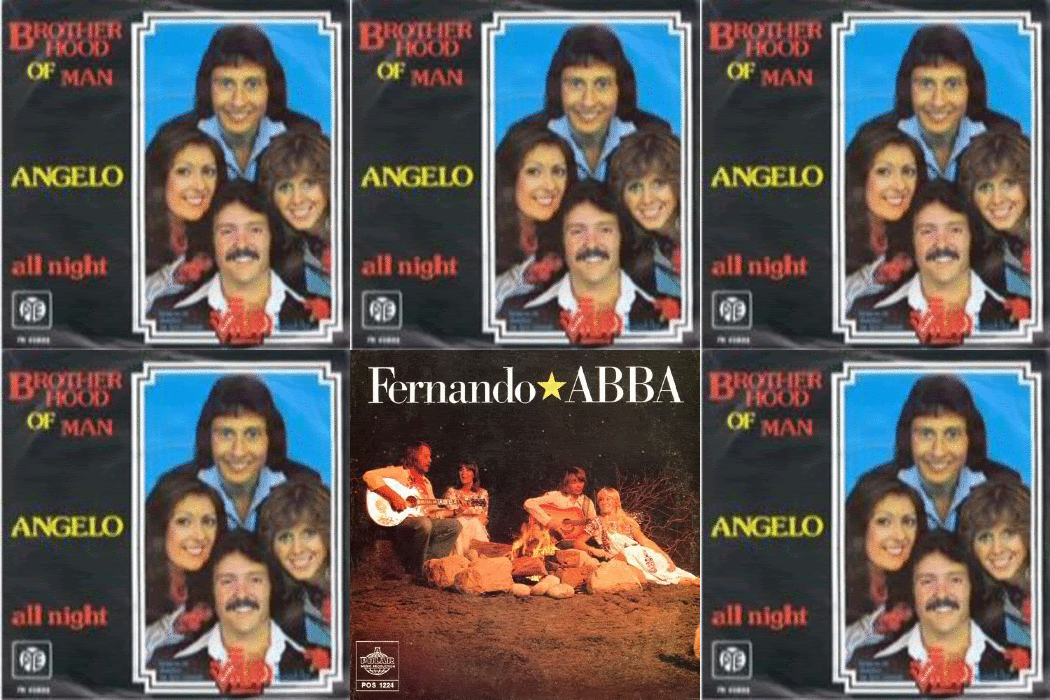
 Now then, what's this? A former Eurovision winning band of two blokes, two women singing a song about some Mexican folks with a title that ends in 'O'. Ah yes, I know, the 'Abba rip-off' comments are a bit lazy - its been done to death on this one, but unfortunately that doesn't make them any less accurate; as Abba were enjoying so much post Eurovision success then why not hitch their cart to that ready made racehorse formula? Why not indeed, and in trying to give their career legs by raising their game from the sickly twee of 'Save Your Kisses For Me', the Brotherhood Of Man offered up this tale of doomed love and suicide.
As I've commented elsewhere, I'm always partial to a song with a story and, as I'm a sucker for a good death ballad too, 'Angelo' should delight. Instead, it leaves me feeling the wrong side of cold. Why? Well for a start the song's 'story' is a model of brevity to say the least; poor boy Angelo falls in love with a rich man's daughter and they run off together to avoid their disapproving parents and......and the next thing you know they're both lying dead in a ditch 'hand in hand'.
Now, I don't expect a three minute pop song to weave a Dickensain web of intrigue, but a little more development than this cynical tug on the heartstrings would have been nice. Because how can you empathise in any way with such tissue thin characters? And perhaps to paper over the shortcomings in the story, 'Angelo' is a little too sharp and shrill to be an enjoyable listen: "they took their lives that night and in the morning light, they found them on the sand, they saw them lying there hand in hand" - such lines are not delivered with a sympathetic tone but with the hardnosed matter-of-factness of two fishwives gossiping over the garden fence. You expect them to follow up with 'I always knew he was a bad lot that Angelo, the baggage'. Elsewhere, 'Angelo' manages to score a plus point with a nice Mariachi drum beat that precedes the chorus, but the gain on the swings is lost on the roundabouts with the shameless (SHAMELESS!) steal of the descending piano motif from 'Dancing Queen'.
'Angelo' is a brash and tacky penny dreadful cash in that's 'Orca: Killer Whale' to Abba's 'Jaws'. Saying that, if on pain of death I was forced to choose which Brotherhood Of Man single I had to listen to on auto repeat while locked in a room for a few decades then I'd probably choose this one. But just because it's the best of a bad bunch that doesn't make it any less irritating.
 Ah now, this one caused me no end of anguish as a lad. Thanks to my home environment, I was introduced to the world of music - and lots of it - at an early age. Bowie, Pink Floyd, Slade et al always seemed to be playing in the background as I was growing up and, as far as The Beatles went, I knew every song off the 'Blue' album by heart before I'd even started junior school; not by indoctrination, but because I genuinely liked them. I still do in fact, but in point of fact before punk and the "No Elvis, Beatles and the Rolling Stones" scorched earth policy of The Clash, there didn't seem to be any alternative but to like them. Because the equation ran: The Beatles = the best band of all time and at age eight, I wasn't inclined to challenge.